
High-Yield Physiology for NBCE Part I: A System-by-System Review
Physiology closes out Session 1 on Part I, right after General and Spinal Anatomy. It's also the domain where students most often say, "I understood it in class, but I couldn't answer the question."
That's because physiology questions rarely ask for a definition. They give you a change, like a drop in blood pressure or a rise in CO2, and ask what happens next. To answer fast, you need the cause-and-effect rules, not just the vocabulary.
This guide covers those rules system by system, with practice questions at the end.
New to Part I prep? Start with our 10-week NBCE Part I study plan.
The Foundations: Feedback, Membranes and Muscle
Feedback loops
- Negative feedback reverses a change and keeps things stable. Most of the body works this way: body temperature, blood glucose, blood pressure.
- Positive feedback amplifies a change until an endpoint. Classic examples: oxytocin during labor, the LH surge before ovulation, and blood clotting.
Membrane potentials
- A typical neuron rests around −70 mV, inside negative.
- The sodium-potassium pump moves 3 Na+ out and 2 K+ in, using ATP. It maintains the gradients the cell depends on.
- Depolarization: voltage-gated Na+ channels open and Na+ rushes in.
- Repolarization: K+ channels open and K+ flows out.
- Absolute refractory period: a second action potential can't fire, no matter how strong the stimulus.
Skeletal muscle contraction
- Acetylcholine is released at the neuromuscular junction and depolarizes the muscle fiber.
- Calcium is released from the sarcoplasmic reticulum.
- Calcium binds troponin, which shifts tropomyosin and exposes binding sites on actin.
- Myosin heads bind actin and pull (the cross-bridge cycle).
- ATP is needed for myosin to release Without it, muscles lock, which is why rigor mortis happens.
Cardiovascular Physiology
The conduction system
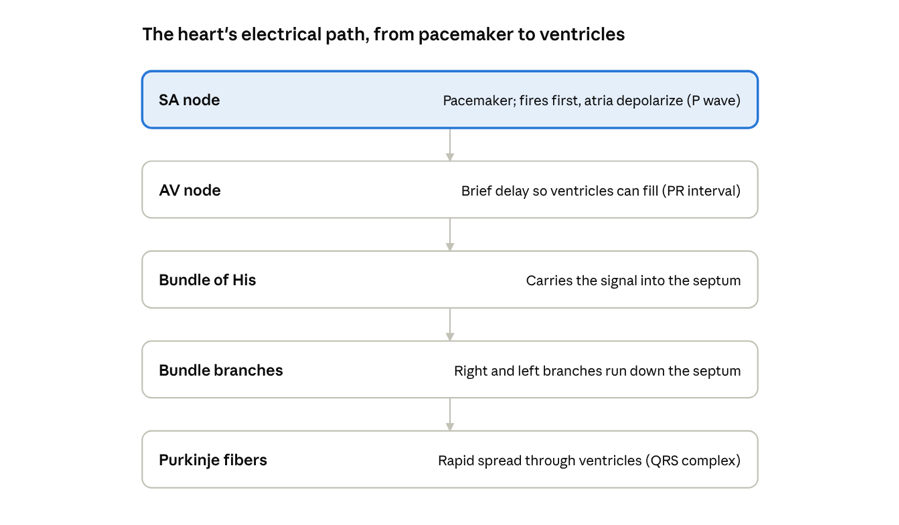
cardiac conduction system
On an ECG, the P wave is atrial depolarization, the QRS complex is ventricular depolarization, and the T wave is ventricular repolarization. Atrial repolarization happens during the QRS, so it's hidden.
Formulas worth knowing cold
|
Formula |
What it means |
|
Cardiac output = heart rate × stroke volume |
How much blood the heart pumps per minute |
|
Mean arterial pressure ≈ cardiac output × total peripheral resistance |
Raise either one and blood pressure rises |
|
Frank-Starling law |
More filling stretches the ventricle, which produces a stronger contraction |
Apply it: when blood pressure drops, baroreceptors in the carotid sinus and aortic arch fire less. The body responds by raising heart rate, contractility and vascular resistance to bring pressure back up. That's negative feedback in action.
Respiratory Physiology
Oxygen-hemoglobin curve shifts
Most oxygen in the blood travels bound to hemoglobin. The oxygen-hemoglobin dissociation curve shows how tightly hemoglobin holds it.
- Right shift: hemoglobin lets go of oxygen more easily, so more is delivered to tissues. Caused by increased CO2, increased acid (lower pH), increased temperature and increased 2,3-BPG. Think of exercising muscle: hot, acidic and full of CO2, exactly where oxygen is needed.
- Left shift: hemoglobin holds oxygen more tightly. Caused by the opposite conditions. Fetal hemoglobin and carbon monoxide also shift the curve left.
CO2 transport
Most CO2 travels in the blood as bicarbonate (HCO3−), made in red blood cells by carbonic anhydrase. Smaller amounts are dissolved directly or bound to hemoglobin.
Control of breathing
- Central chemoreceptors in the medulla respond mainly to CO2, sensed as changes in H+ in the cerebrospinal fluid. This is the main everyday driver of breathing.
- Peripheral chemoreceptors in the carotid and aortic bodies respond mainly to low oxygen.
Renal Physiology
What each part of the nephron does
|
Segment |
Main job |
|
Glomerulus |
Filters blood plasma (normal GFR is roughly 125 mL/min) |
|
Proximal convoluted tubule |
Reabsorbs most filtered sodium and water, and normally all filtered glucose and amino acids |
|
Loop of Henle |
Builds the concentration gradient in the medulla (countercurrent multiplier) |
|
Distal convoluted tubule |
Fine-tunes sodium; site of parathyroid hormone's calcium reabsorption |
|
Collecting duct |
Final water and sodium adjustment, controlled by ADH and aldosterone |
ADH vs aldosterone
These two hormones get mixed up constantly. Here's the difference:
|
|
ADH (antidiuretic hormone) |
Aldosterone |
|
Made in |
Hypothalamus (released from posterior pituitary) |
Adrenal cortex |
|
Main trigger |
High blood osmolality |
Angiotensin II; high blood potassium |
|
Main action |
Adds water channels (aquaporins) in the collecting duct, so water is reabsorbed |
Increases sodium reabsorption and potassium secretion |
|
Net effect |
More concentrated urine |
More sodium and water retained, more potassium lost |
The RAAS chain: low blood pressure → kidney releases renin → angiotensinogen becomes angiotensin I → ACE (mainly in the lungs) converts it to angiotensin II → vasoconstriction and aldosterone release → blood pressure rises.
Endocrine Quick Review
Endocrine questions usually ask where a hormone comes from or what it does. Learn hormones in opposing pairs where you can.
|
Hormone |
Source |
Main action |
|
Insulin |
Pancreatic beta cells |
Lowers blood glucose; promotes storage |
|
Glucagon |
Pancreatic alpha cells |
Raises blood glucose; promotes breakdown of glycogen |
|
Parathyroid hormone (PTH) |
Parathyroid glands |
Raises blood calcium |
|
Calcitonin |
Thyroid C cells (parafollicular cells) |
Lowers blood calcium |
|
Thyroid hormones (T3, T4) |
Thyroid follicular cells |
Increase metabolic rate |
|
Cortisol |
Adrenal cortex |
Raises blood glucose; suppresses inflammation and immune response |
|
Epinephrine |
Adrenal medulla |
Fight-or-flight: raises heart rate and blood glucose |
|
Oxytocin |
Hypothalamus (released from posterior pituitary) |
Uterine contraction; milk letdown |
Memory hook: "calci-TONE-in tones down calcium." PTH does the opposite.
Test Yourself: 5 Practice Questions
Cover the answers, commit to a choice, then check.
- During intense exercise, muscle temperature and CO2 rise and pH falls. How does this affect the oxygen-hemoglobin curve? A. Shifts left, increasing oxygen delivery B. Shifts right, increasing oxygen delivery C. Shifts right, decreasing oxygen delivery D. No change
- Which structure is the heart's normal pacemaker? A. AV node B. Bundle of His C. SA node D. Purkinje fibers
- Where is most filtered sodium and water reabsorbed in the nephron? A. Proximal convoluted tubule B. Loop of Henle C. Distal convoluted tubule D. Collecting duct
- Which hormone lowers blood calcium? A. Parathyroid hormone B. Calcitonin C. Cortisol D. Aldosterone
- Why does rigor mortis occur after death? A. Calcium can no longer bind troponin B. Acetylcholine release stops C. Without ATP, myosin can't detach from actin D. Tropomyosin permanently blocks actin
Answers
- Heat, acid and CO2 shift the curve right, so hemoglobin releases more oxygen to working muscle.
- The SA node fires first and sets the heart rate.
- The proximal tubule does most of the bulk reabsorption.
- Calcitonin tones down calcium; PTH raises it.
- ATP is needed to release the myosin head from actin, so muscles lock when ATP runs out.
Missed one? Add it to your miss log, as we describe in our Part I study plan.
Physiology FAQs
How should I study physiology for NBCE Part I? Focus on cause and effect. For each system, practice predicting what happens when one variable changes, like blood pressure dropping or CO2 rising. That's how most questions are framed.
What causes a right shift in the oxygen-hemoglobin curve? Increased CO2, increased acidity (lower pH), increased temperature and increased 2,3-BPG. A right shift means hemoglobin releases oxygen more easily to the tissues.
What's the difference between ADH and aldosterone? ADH mainly makes the collecting duct reabsorb water. Aldosterone mainly increases sodium reabsorption and potassium secretion, with water following the sodium.
When is Physiology tested on NBCE Part I? In Session 1, after General Anatomy and Spinal Anatomy. See the NBCE Part I exam page for current details.
What should I review alongside physiology? Our spinal anatomy review covers another Session 1 domain, and our biochem pathways guide connects closely to cellular physiology.
Turn Understanding Into Points
Most students understand physiology in class. The challenge on boards is applying it in under a minute, question after question.
The Chiro AlignEd Learning Part I Review Course is built for exactly that:
- Exam-aligned lessons that teach physiology as cause and effect, the way it's tested
- Searchable videos so you can revisit conduction, curve shifts or RAAS in seconds
- Quizzes and full-length practice exams to make fast application automatic
- Access Until You Pass™ Guarantee: meet our Exam Readiness Standards and if you don't pass, we renew your 90 days of access at no cost
"What stood out most was how familiar the exam felt." — Hillary W., Part I Review student
Start the Part I Review Course →
Want more free reviews like this one? Get weekly board exam content in your inbox.
Don't Miss Any Tips!
New tips, tactics and strategies for effective studying and test-taking sent straight to your inbox.
We hate spam. We will never sell your information, for any reason.
