
The 6 DXI Categories on NBCE Part III (And How to Study Them)
If you’re preparing for the NBCE Part III exam with Diagnostic Imaging Interpretation (DXI), understanding how the exam organizes imaging content is just as important as knowing individual diagnoses.
DXI questions often feel more difficult than they should—not because the material is impossible, but because chiropractic students don’t always realize what the NBCE is actually testing. DXI isn’t about spotting abnormalities in isolation. It’s about clinical reasoning through imaging.
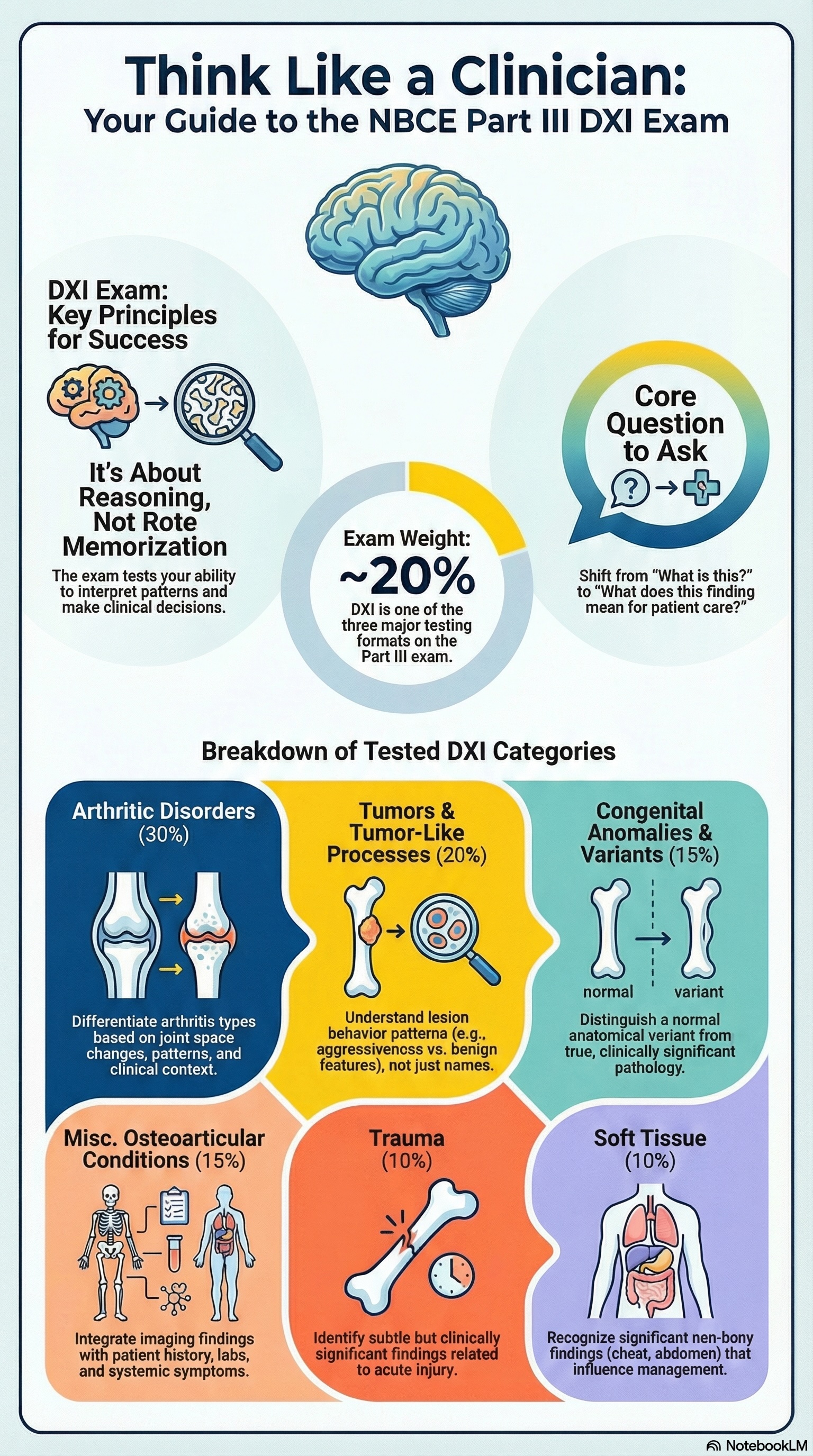
The DXI section makes up approximately 20% of NBCE Part III, and it’s one of the three major testing formats on the exam, alongside traditional multiple-choice and extended multiple-choice cases. Knowing the categories ahead of time helps you study smarter, reduce overwhelm, and approach DXI questions with confidence.
Below are the six DXI categories tested on NBCE Part III and how to think about each one from a board-exam perspective.
1. Arthritic Disorders (30%)
Arthritic disorders represent the largest portion of DXI questions on Part III. These questions assess your ability to recognize imaging patterns and differentiate between types of joint disease.
Common subgroups include:
- Degenerative arthritis (DJD/osteoarthritis)
- Inflammatory arthritis (rheumatoid arthritis, seronegative arthropathies)
- Metabolic or crystalline arthropathies (gout, pseudogout)
Why this matters for boards:
NBCE rarely tests arthritis as a simple “name this condition” question. Instead, you’ll be expected to interpret joint space changes, bone response, distribution patterns, and clinical context to determine the most likely diagnosis and appropriate management.
2. Congenital Anomalies and Skeletal Variants (15%)
This category focuses on recognizing normal anatomical variants and congenital differences that can mimic pathology but may not require intervention.
Common topics include:
- Transitional vertebrae
- Congenital spinal anomalies
- Skeletal variants and structural deformities, including scoliosis
Why this matters for boards:
DXI questions often test whether you can distinguish a normal variant from true pathology. Mistaking a variant for disease—or vice versa—is a common way chiropractic students lose points.
3. Trauma (10%)
Trauma DXI questions assess your ability to identify imaging findings related to acute injury, including:
- Fractures
- Dislocations
- Alignment abnormalities
- Associated soft-tissue clues
Why this matters for boards:
Trauma questions frequently combine imaging findings with mechanism of injury and clinical presentation. You’re expected to recognize when findings are subtle but clinically significant.
4. Tumors and Tumor-Like Processes (20%)
This category evaluates your ability to interpret imaging features of:
- Benign tumors
- Primary malignant bone tumors
- Metastatic disease
- Tumor-like lesions
Why this matters for boards:
NBCE emphasizes lesion behavior patterns—such as margins, growth rate, and bone response—rather than memorizing every tumor type. Understanding aggressiveness versus benign features is key.
5. Miscellaneous Osteoarticular Conditions (15%)
This is a broad category that includes skeletal findings related to systemic conditions, such as:
- Infection (e.g., osteomyelitis)
- Hematologic or vascular disorders
- Endocrine and metabolic disease
- Nutritional deficiencies
Why this matters for boards:
These questions often require you to integrate imaging findings with patient history, labs, or systemic symptoms to arrive at the correct interpretation.
6. Soft Tissue (10%)
DXI is not limited to bones. Soft tissue imaging includes evaluation of:
- Chest and lung fields
- Abdominal findings
- Non-osseous structures visible on plain film
Why this matters for boards:
Part III tests your ability to recognize clinically significant non-bony findings that influence diagnosis, referral, or management decisions.
Frequently Asked Questions About NBCE Part III & DXI
How much of NBCE Part III is DXI?
DXI accounts for about 20% of the Part III exam. While it’s not the majority of the test, DXI questions often feel more challenging because they require interpretation and clinical reasoning rather than pure memorization.
What types of DXI questions are on Part III?
DXI questions are typically image-based or description-based and may ask you to:
- Interpret radiographic findings
- Identify the most likely diagnosis
- Determine whether imaging is appropriate
- Recognize red flags requiring referral or further imaging
The emphasis is on what the imaging means for patient care, not just identifying abnormalities.
Do I need to memorize every radiographic condition for DXI?
No. Trying to memorize every condition is one of the biggest mistakes chiropractic students make.
NBCE Part III rewards:
- Pattern recognition
- Understanding disease behavior
- Knowing how imaging findings affect management
If you understand categories, common patterns, and key differentiators, you’ll perform far better than relying on memorization alone.
Are DXI questions mostly spine-focused?
The spine is heavily represented, but DXI questions also include:
- Extraspinal joints
- Chest and abdominal imaging
- Soft tissue findings
That’s why understanding all six DXI categories is essential for balanced preparation.
Do I need to know MRI or CT for DXI?
DXI primarily focuses on plain-film radiography, but you are expected to know:
- When X-ray is appropriate
- When advanced imaging is indicated
- When imaging findings require referral
Part III tests imaging appropriateness, not advanced modality interpretation.
How is DXI different on Part III compared to Part I or II?
Part III DXI is more clinical and decision-based.
Instead of simply asking “What is this finding?”, questions often ask:
- What does this finding mean clinically?
- What is the next best step?
- Is further imaging or referral required?
This shift is what makes DXI feel more challenging—but also more manageable once you understand the framework.
What DXI topics do chiropractic students miss most often?
Chiropractic students most commonly struggle with:
- Differentiating degenerative vs inflammatory arthritis
- Recognizing normal variants versus pathology
- Identifying tumor aggressiveness patterns
- Knowing when imaging is not indicated
These are reasoning errors—not a lack of intelligence or effort.
Is DXI more about memorization or reasoning?
DXI on Part III is heavily reasoning-based. You’re expected to integrate:
- Patient age and history
- Imaging descriptors
- Risk factors and red flags
This is why studying DXI by category and pattern is far more effective than flashcards alone.
How should I study DXI differently than other Part III sections?
Effective DXI study includes:
- Learning category-specific imaging patterns
- Comparing look-alike conditions side-by-side
- Practicing clinical decision-making
- Understanding referral and imaging appropriateness
This mirrors how NBCE constructs DXI questions.
What’s the biggest mindset shift needed for DXI success?
Stop asking:
“What is this image?”
Start asking:
“What does this finding mean for patient care?”
That mindset shift alone can significantly improve DXI performance.
Final Takeaway
DXI on NBCE Part III isn’t designed to trick you—it’s designed to assess whether you can think like a clinician using imaging. Understanding the six DXI categories gives you a roadmap for how the exam is structured and how to study efficiently without burnout.
This category-based, pattern-driven approach is exactly how we structure our upcoming NBCE Part III DXI review, helping chiropractic students build confidence through clinical reasoning—not memorization.
Don't Miss Any Tips!
New tips, tactics and strategies for effective studying and test-taking sent straight to your inbox.
We hate spam. We will never sell your information, for any reason.
